So I've always been obsessed with titles of novels and plays. How do these titles relate to the plot or theme or characters? Sometimes the titles are so obscure that I just give up. In our last discussion of the novel, we were discussing the Duke's motives and his actions. He wanted to whip the people back into shape because they were lazy fat lions. By giving power to Angelo, a cold-hearted tyrant, the Duke is effectively ensuring people began to obey the rules without doing so himself. The Duke is also analyzing or "measuring" the performance of Angelo in his absence. Is he really a good employee? Is he someone to be trusted? It's cool, I guess. So I figured that's why the play is entitled Measure for Measure; the Duke is measuring Angelo's performance. But, when I think of the phrase "measure for measure," it reminds of "what goes around comes around" or "you reap what sow." I just think it means that I'll give you or do to you exactly what you give me or do to me. So I was trying to figure out how the Duke is able to apply the punishment or sentence that Angelo deserves. In my opinion, Angelo doesn't get what he deserves. He gets married. What kind of punishment is that for almost executing a man and blackmailing a female into sex. This isn't "measure for measure." I'm just confused. I guess it all ties back into idea of mercy and justice as we discussed in class. Though, I may think death or at least jail would have righted the wrongs of Angelo, maybe an unwanted marriage was a far worst punishment. Welp...here my thoughts to wrap up Measure for Measure.
Blog Challenge Post 2 of 5.
Saturday, November 9, 2013

Friday, November 8, 2013
Elizabethan Reality: "Undercover Duke"

As we were wrapping up our final
thought on Measure for Measure
last class, I couldn't help but notice how this play can parallel as an Elizabethan version of “Undercover Boss.” For those that are
unfamiliar with this television show, “Undercover Boss” follows CEO's who
disguise themselves and go to work base-level jobs inside their own
businesses unbeknownst to their employees. As amusing as this might
sound, I envision the Duke as being the original
“undercover boss.”
I realize several people were annoyed
with the Duke for leaving his post; and, in some ways, I can see how
the Duke could be blamed for everything going to pot in his
absence. The Duke did leave an immoral hypocrite in power when he clearly should not
have been in any sort of authoritative role. Furthermore, his being MIA nearly culminated in the loss of a life that could have been preserved under his own rule. But
I personally found myself much more amused than annoyed with the
Duke. To some extent, I even wanted to congratulate him for setting things
up so Angelo's corruption was so clearly unveiled. If the Duke hadn't
left and Angelo hadn't risen to such a level of control, Angelo's
true character and nature would not have been revealed to the extent that it
ultimately was. If all this hadn't happened, Angelo would have remained with
power he was underserving of. In fact, I believe that perhaps the
Duke's “holiday of sorts" was a rather bold and clever scheme that can be
easily likened to the modern reality show - “Undercover Boss.” Using his disguise, the Duke was able to see firsthand the ways issues were dealt with in his absence, just as the CEOs in the show are able to
nose around their businesses as disguised employees to analyze efficiency, productivity and customer service elements, etc.
This link will connect you to a more visual representation of the kind of snarky B.A. reveal I would like to imagine the Duke pulls off when he pitches his friar disguise to the wayside.
http://www.youtube.com/watch?v=6ZYvt_pEolo
Wednesday, November 6, 2013
Another example of Mephistopheles ruinin' some lives (though Faustus had it coming)
SWOOSH
That's the sound of us traveling back in time to when I originally meant to post this, while we were reading Doctor Faustus. (It's interesting to me how many of us continue to post about this play. We all have so much to say that didn't fit into our class time!)
Anyway, what I was thinking about the whole time we wee learning about this play, was the album by the Trans-Siberian Orchestra, "Beethoven's Last Night." (Yes, they do have albums that have music other than Christmas.)
This album is a concept album which means that it tells a single story through the songs. It also comes with a booklet where you can read the story along with it.
The premise of this story is that it is Beethoven's last night on earth. He is going to die that night (though he doesn't know this at the beginning.) He is working on his tenth symphony when he is visited by Mephistopheles who tells him that he has come to collect his soul. he then makes him to offer that if Beethoven gives Mephistopheles all his music and allows him to wipe the memory of his compositions off the face of the earth, he will give him back his soul. The story is about Beethoven trying to decide what he wants.
Obviously this story of making contracts with the devil is a popular one, since we see it so often throughout literature. In the Canterbury Tales, there's also a story of a man meeting with the devil.
You can read the basic story here.
This song is called "Mephistopheles" and is sung by- you guessed it- Mephistopheles as he introduces himself:
And in this next video you can listen to the whole album (which you totally don't have to but there's some musical masterpieces in there (in my opinion of course!)
My favorite is "Mephistopheles' Return," in case you were wondering :)
Faustus's Fear of the Question Mark
Originally
as I read Doctor Faustus in
a the literal sense, I was genuinely bothered and perplexed by
Faustus's act of selling his soul to the devil. I couldn't imagine
what drove him to go to such extreme measures. Eventually, I found
peace in a more figurative reading, but I also settled on the idea
that Faustus just couldn't handle uncertainty.
This
uncertainty that Faustus tries to shake begins as soon as he
signs the bloodily- instated contract. What does he do immediately? He
asks about Hell – he wants to know about something unknown. Faustus must have been aware that, in Heaven, souls would be privy to
“knowing all,” but he wasn't willing to wait to find out if he'd
ever even get there. So Faustus decides to find another route to a
state of “enlightenment:” through the devil.

Now
I know I mentioned this a few weeks back when we were actively
discussing this play, but I never completely voiced my final thoughts
on the subject. And the more I think about it, the more I believe
that, given what we learn about Faustus's character, this scholarly
character was not keen on anything
abstract or ambiguous. After all, as an intelligent fellow in the
business of learning, it would seem easy for him to neglect to leave
room for the spiritual aspect of faith.
And this proves to be what ultimately ends up getting him into
trouble.
Faustus
displays a lack of faith inasmuch he refuses to trust that God would
allow his salvation before his “great sin” (the contract), but
also after. He fails to believe God will protect him should he
attempt to repent; and although the demons threaten to tear him apart
should he try to flee Hades's grasp, was this not that his final fate
anyway? What did he have to lose? He had Heaven to gain if his
redemption was accepted and only to fall back on his future in Hell
if not!

In
this piece, it is clear that well-educated and intelligent Faustus
aspires to know all. It is no fluke these characteristics are
present for they are vital for his character development. To use a
cliché, knowledge is power to Faustus. He believes he can take
authorial power over his fate, taking it into his own hands. But in
the end, does Faustus believe that eliminating uncertainty is
really worth the cost?
Tuesday, November 5, 2013
Sin & Salvation as it Pertains to Faustus's Contract
So,
as I read Doctor Faustus, I
found myself wondering what exactly was meant by the act of selling
one's soul to the Devil. What does this “transaction”
so-to-speak precisely entail? For one thing, Faustus obviously
deliberately turns away from God and essentially “does business”
with the devil. But what do these satanic dealings mean in terms of
his salvation in the long run? If continued without repentance, we
assume he's guaranteed a spot in Hell. And according to the play, he
is indeed eternally
damned. Moreover the “contract,” which
is signed with blood, seemingly signifies a level of permanence.
Yet doesn't every contract have its own set of loopholes?
Furthermore, if this deal with the devil is permanent and Faustus's
fate is sealed, why did we discuss mercy
in class? And why are we asking ourselves when Faustus reaches the
“point of no return” (where not even God will take him back) in this tale? All
this leads me to believe that this “contract” is only as “good”
as the parties involved make it. So if one wanted out
(eg: a repentant Faustus), it would have been nullified. After all, we're led to
believe God is all-merciful if we are penitent. . .right?

The Duke of Dork
I've struggled with this, but I just do not like the Duke. Whenever I picture him I see this:
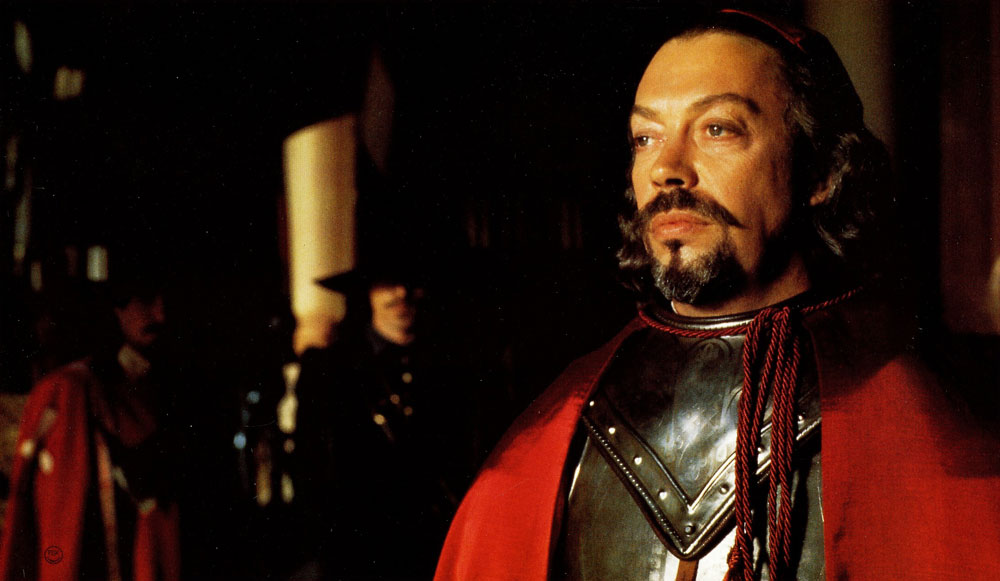
Just ewww.
So now that you have Tim Curry playing the ever sleazy Cardinal from "Three Musketeers" (the real one) in your head, I'm going to give you Sara's Top Ten Reasons The Duke Stinks
1. He forces Angelo to take on his job and then sneaks back in to spy on him.
2. He dresses as a friar and uses the disguise to manipulate Isabella and Marianna.
3. He tells Marianna that replacing Isabella is not a sin because she has a contract with Angelo - the same conditions under which Claudio has been condemned and Juliet imprisoned.
4. He manipulates Isabella and Marianna for pretty much the entire play.
5. He uses Claudio's death, or lack thereof, as leverage against Isabella - not telling her until just before he pops the question.
6. He punishes the daylights out of Lucio for things he says to/about him while he is disguised as the Friar. Yes, I get it, Lucio is really annoying but the punishment was petty and personal. Making an honest woman of the prostitute he left with child would have sufficed.
7. He doesn't solve anything! All of his worry about lax follow through of laws and his actions ends with a petty round of an eye for an eye or "Measure for Measure."
8. He uses his sneaky leverage to get the girl - I think. As far as I can tell, Isabella never says yes.
9. He expects Angelo to do the job he is not capable of and faults him for being as lecherous as himself (If Lucio is to be believed).
10. Well, number ten is - All of this adds up to a Duke who is as much of a "scum canoe" as Angelo.
2 of 5
Mercy and Justice more like Mercy OR Justice
While reading the end of the play, I couldn't get the discussion we had in class about Mercy and Justice out of my mind. I was subconsciously asking myself if mercy was being given or if justice was served. I was starting to get annoyed at how much thought I was putting into this topic, and then in the last act of the play, I realized mercy and justice, while they are applicable to anyone's life, are up to the readers interpretation.
The end of the play seems kind of abrupt, like Shakespeare got tired of writing and just wanted to be done, there really isn't much explanation to the decisions that are made by Angelo, Marianna, The Duke, and Isabella. Which at first didn't make any sense but after reading the act one more time. I realized that, at least in my eyes, mercy isn't given and justice isn't served.
The way I see it, Angelo settles for Marianna because he finally had someone who would have sex with him. He married her solely for one reason and one reason only. He could care less what happens to her as long as she is where he needs to her to be, when he wants it. As for Isabella completely abandoning her path to the nunnery and marrying The Duke. It's almost as if Isabella knew that she was not going to have the same kind of respect as the other Nuns because of her and her brothers actions, that she just said screw it.
Even after reading this act multiple times, I'm still baffled by the outcome.
Subscribe to:
Posts (Atom)