Going through everything that we have read in this course, I stumbled upon the sermon that had to be read in England once a month, every month during the sixteenth century. For a little recap on what it was about: the sermon was composed of twelve different parts; one for each month of the year essentially. These sermons highly emphasized the divine authority given to the monarchs of England. This caused uprisings from the Catholics, and England continually swayed between Catholicism and Protestantism with the rise and fall of different monarchs.
That being said, analyzing the first Homily that was provided for us on blackboard, I am astonished that people would have to listen to this once a month. The consistency of the sermon probably played the role of "brain-washing" to the British people. It speaks about obedience above all other virtues and specifically obedience to the monarch of England. Listening to this would be tough once Gutenberg invented the printing press and people started reading the Bible for themselves. Some Bible verses that oppose what the homily says are:
Proverbs 29:2, "When the godly are in authority, the people rejoice. But when the wicked are in power, they groan." (New Living Translation)
Acts 5:29b, "We must obey God rather than any human authority." (New Living Translation).
These words oppose much of what the homily says, yet there are also verses that support the homily as well...
Romans 13:1-2, "Everyone must submit to governing authorities. For all authority comes from God, and those in positions of authority have been placed there by God. So anyone who rebels against authority is rebelling against what God has instituted, and they will be punished." (New Living Translation)
This verse takes the homily and pretty much summarizes it into two sentences. So it is good that the homily has Biblical verses to back up what it is saying, but it does not take into consideration everything the Bible has to say about authority, and more specifically God's authority.
In addition, the homily is written in lofty, "chuch-y" words that make people think that what is being said really is truth. People did not talk that sophisticated then, and we still do not achieve that extent of loftiness in today's society either. The language itself makes it hard to dispute, but surely there were people who analyzed the sermons for what they really were.
If this were to be preached in today's society, I highly doubt the pastor would be able to make it through the first page without people walking out of the door or standing up to protest. Christianity in general has changed drastically, and one of the biggest differences has been the fact that people can read the Bible for themselves. This keeps pastors and priests accountable for their sermons, and monarchs cannot persuade churches as much nowadays as they did in the sixteenth century.
It is crazy how much society has changed, and I have truly enjoyed looking at the progress of British society in this class through a literary standpoint.
Blog challenge: 6 of 5... say wha'?? :)
Showing posts with label Christianity. Show all posts
Showing posts with label Christianity. Show all posts
Tuesday, December 10, 2013

Saturday, November 16, 2013
Trying to decipher Milton's universe
Although I do not know very much about Milton's religious practices, by reading Paradise Lost I imagine him to be as devout of a Christian as Thomas More. (But then again Utopia is not a religious novel, so Milton's actual beliefs may not have aligned perfectly with his work either.) Whatever the case may be, it is a bit confusing to follow the layout of the universe through Milton's eyes.
Starting with what we do know... There is definitely a heaven and a Hell, and they are as far away from each other as they possibly can be. Also, we get the sense that Hell is below Heaven because after all, the angels, Lucifer included, "fall." (Interesting side note: the use of the word "fall" is present in Christianity when one talks about one-third of the angels from heaven as well as the first sin of mankind. Both relate to Lucifer...) Anyways, the confusing part about Milton's universe is this idea of chaos separating Heaven and Hell, and where does earth come into the picture too. The only way to truly picture this is with a picture so...
Reference: http://web.ics.purdue.edu/~felluga/geo.gif
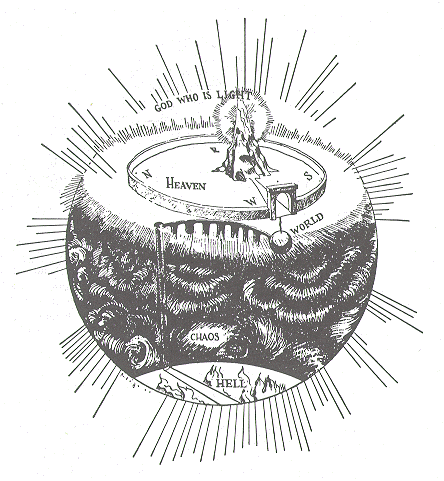
This is a pretty good way to depict Milton's universe, and I have found that this knowledge helps me also understand the plot in a more visual way. It is interesting to take into account just how massive Heaven and Hell are compared to the earth. Not only does this help us picture how huge Gad and Satan are, but it also plays an important role in the storyline. Paradise Lost starts out as a story focused on the world and one guy, but then it blossoms into a story of the battle between God and Satan about earth. Therefore, earth is not as important and therefore not as "big" in the picture of the universe. I hope this helps visual learners better understand this book.
Blog Challenge: 2 of 5!!!
Tuesday, October 15, 2013
Thomas Moore and his Utopia... is it different from the one he wrote about?
Thomas More proposed very radical ideas in his book Utopia, and one very interesting idea is that of the freedom of religion. Citizens were not required to become a part of any religion; they were not required to pay tithes to the local church. Commitment to any religion was not required at all. This is interesting coming from the work of More though; he was an extremely devout Christian like we talked about in class. (I will never forget the grotesqueness of the horse hair that he piously wore under everything.) That being said, most devout Christians believe that everyone should also be a Christian and that everyone should be as committed as they were. Christians today still reach out to places all over the world. However, More decided to let people choose whether or not they wanted to be a Christian in his Utopian society. This is ultimately because the freedom of choice also allows people to see who are truly devout in their faith and those that are not. If it is required to go to church, anyone can pretend to know more about their faith because they hear about it every weekend. But if it is not required, people can no longer pretend as well as they used to. The freedom of religion allows for God to be the judge of someone's heart, not man. This is ultimately what I believe More longs for in the end.
Sunday, September 8, 2013
Religion in Beowulf
So, full disclosure before I begin: in my senior year of high school, we read Beowulf and discussed religion in it so I'm coming in with previous knowledge already. That was three years ago though, so it's a bit of a stretch to remember.
Grendel and his mother are referred to as descendants of Cain (99-114). Also listed are "ogres, and elves, and evil phantoms and the giants" (112-113). These monsters are not found in Christianity but are from different mythologies that existed before Christianity was introduced to the Anglo-Saxons.
The culture we see in Beowulf is in a state of transition from paganism to Christianity and because this happens over a long period of time, the two religions mix and create a hybrid of the two.
Another time that this is apparent is in line 1690 when Hrothgar begins his speech to Beowulf after Beowulf brings back Grendel's severed head. Hrothgar examines the sword and the text tells us that there are engravings of the past on the hilt and references when "the flood destroyed the tribe of giants." This story is recognizable to us as the story of Noah and the Ark. However it is presented to us as yet again a mixture of Christianity and paganism.
I'm sure there's other ways that religion plays a part in Beowulf and would be really interested to hear anyone else's opinions!
One of things I notice most about Beowulf is the peculiarity of the religion. From the text, it's pretty obvious that Christianity is the dominant philosophy, both from the context of the story (late 5th century) and the references made by the characters to God and some biblical stories.
There are also aspects of paganism, though these are often subtler. The speaker seems to condemn paganism as an older religion which is not believe in anymore:
"Sometimes at pagan shrines they vowedHowever, if we look closer at some of the Christian aspects that re present, we can see that there is a sort of hybrid between Christianity and paganism shown.
offerings to idols, swore oaths
that the killer of souls might come to their aid
and save the people. That was their way,
their heathenish hope; deep in their hearts
they remembered hell. The Almighty Judge
of good deeds and bad, the Lord God,
Head of the Heavens and High King of the World,
was unknown to them." (175-183)
Grendel and his mother are referred to as descendants of Cain (99-114). Also listed are "ogres, and elves, and evil phantoms and the giants" (112-113). These monsters are not found in Christianity but are from different mythologies that existed before Christianity was introduced to the Anglo-Saxons.
The culture we see in Beowulf is in a state of transition from paganism to Christianity and because this happens over a long period of time, the two religions mix and create a hybrid of the two.
Another time that this is apparent is in line 1690 when Hrothgar begins his speech to Beowulf after Beowulf brings back Grendel's severed head. Hrothgar examines the sword and the text tells us that there are engravings of the past on the hilt and references when "the flood destroyed the tribe of giants." This story is recognizable to us as the story of Noah and the Ark. However it is presented to us as yet again a mixture of Christianity and paganism.
I'm sure there's other ways that religion plays a part in Beowulf and would be really interested to hear anyone else's opinions!
Subscribe to:
Posts (Atom)