Showing posts with label SaraP. Show all posts

Saturday, December 14, 2013

British Literature Fall 2013 Top 5

December is the point at which we tend to pause and consider the past year. Everywhere you look there are top ten lists of 2013, tributes to the ones we have lost and the nation takes on a reflective tone as we ready to launch into a new year. Reviewing for the final exam for this class has fit nicely with this contemplative theme. Rereading key bits of each text brings the characters and themes back into sharp focus, for better or for worse, and I can't stop myself from categorizing them into my own top 5's.
Top 5 Villains: 5)The Grendel - Beowulf 4)The Duke - Measure for Measure 3)Angelo - Measure for Measure 2)Mephistopheles - Dr. Faustus 1)Satan - Paradise Lost Satan earns this dubious distinction because - well he's Satan. Additionally, he is the perfect study of a good man gone bad. He was once an angel, after all. Most importantly, Satan has the most awesome arch enemy of all. Speaking of which...
Top 5 Heroes: 5)Beowulf - Beowulf 4)The Wife of Bath - Canterbury Tales 3)Isabella - Measure for Measure 2)Oroonoko - Oroonoko 1)God - Paradise Lost God is the easy winner because, like Satan, he is of legendary proportion. He is also the only hero without flaws, which skews the playing field a bit. Doesn't a hero need flaws? Regardless, it is my top 5.
Most Interesting Character: The Wife of Bath Honorable Mention: Satan - Paradise Lost This was a difficult decision, because Satan is such a round and, at times, empathetic character. The Wife of Bath takes the honors because she is a kick-butt female character in a time before heroines. Sure, she is a bit of a parody, but I feel her strength overrides any comic factor she has.
Most Pathetic Lead: Tie: Gulliver - Gulliver's Travels & Faustus - Dr. Faustus Equally weak and despicable, these two men lack the backbone to be anything more than a cautionary tale. Gulliver's sense of self is easily compromised,as evidenced in his willingness to identify with horses after his return to England and Faustus, well, Faustus is just a very lonely, weak man. Place I would least like to visit: Utopia No privacy, no thank you. Way too much togetherness, not enough identity and I have the sneaky suspicion I would be stuck as a full time farmer. I humbly submit, my Top 5's of Brit. Lit. Fall 2013 5 of 5 WOOT!

Thursday, November 14, 2013

Spoiled Children, Homilies Against Disobedience, and other Milton Musings

I'm a mom and have spent most of the last ten years at home raising two boys. This dimension of my life colors my perceptions and translates into my literary interpretations with alarming regularity. Because of this, what struck me the most from Book I of "Paradise Lost" was the parent/child relationship portrayed between God and Heaven's most infamous fallen angel. God, of course, is firmly entrenched in Christian dogma as the Father of mankind, however; I hadn't considered the idea that this paradigm could extend from the realm of Heaven to the depths of Hell.
Satan is introduced as he is awakening to the consequences of his failed attempted coup. Literally stunned from falling from this unimaginable height, he is also shocked that he has failed, as well as hurt and angered by his expulsion from Heaven. His response is anything but mature. After comforting his troops, he assuages his himself with a demonic version of "Fine! I didn't need you anyway!" Instead of seeking forgiveness and possible reconciliation, he vows to devote his existence to thwart God. He will subvert good and spread evil for all of eternity. God's response is, of course, brilliant and benevolent. Instead of heaping further punishments on Satan, he shines mercy upon all who stray to evil. Satan's actions continue to heap pain and confusion upon his own soul. Much like a parent will give a rebellious child just enough room to learn a lesson, God extends free will to the devil, but he refuses to learn.
Another thing that gave me reason to pause, was the repeated use of the word "rebel" in all its various forms. I was immediately reminded of the "Homily Against Disobedience" which is also liberally sprinkled with the word. Given the history it seems highly likely that Milton makes Satan's mistake that of rebellion to reenforce state propaganda. Whether Book II confirms my hunch or not remains to be seen.


3 of 5

Tuesday, November 5, 2013

The Duke of Dork

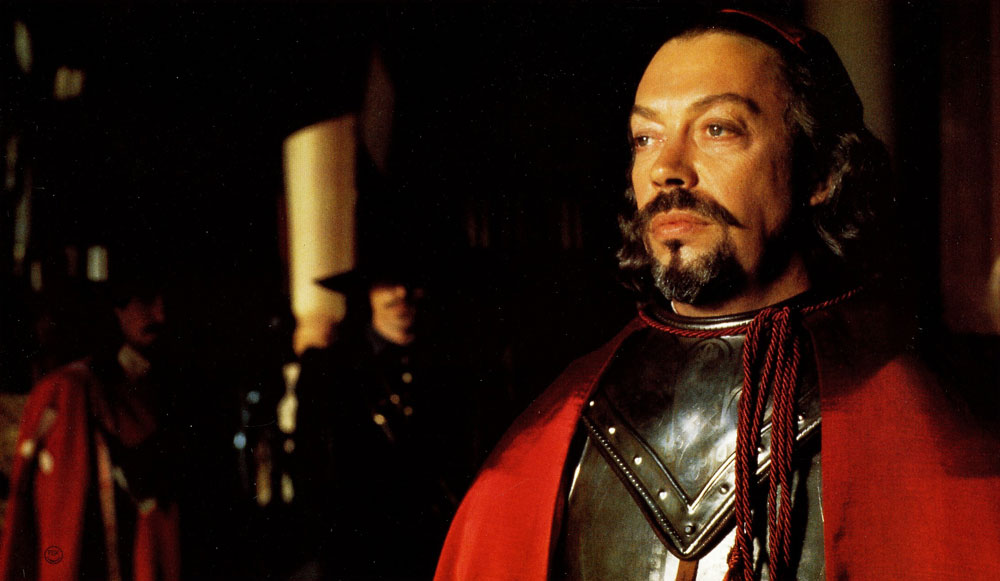
I've struggled with this, but I just do not like the Duke. Whenever I picture him I see this:


Just ewww. 
So now that you have Tim Curry playing the ever sleazy Cardinal from "Three Musketeers" (the real one) in your head, I'm going to give you Sara's Top Ten Reasons The Duke Stinks

1. He forces Angelo to take on his job and then sneaks back in to spy on him.

2. He dresses as a friar and uses the disguise to manipulate Isabella and Marianna.

3. He tells Marianna that replacing Isabella is not a sin because she has a contract with Angelo - the same conditions under which Claudio has been condemned and Juliet imprisoned.

4. He manipulates Isabella and Marianna for pretty much the entire play.

5. He uses Claudio's death, or lack thereof, as leverage against Isabella - not telling her until just before he pops the question.

6. He punishes the daylights out of Lucio for things he says to/about him while he is disguised as the Friar. Yes, I get it, Lucio is really annoying but the punishment was petty and personal. Making an honest woman of the prostitute he left with child would have sufficed.

7. He doesn't solve anything! All of his worry about lax follow through of laws and his actions ends with a petty round of an eye for an eye or "Measure for Measure."

8. He uses his sneaky leverage to get the girl - I think. As far as I can tell, Isabella never says yes.

9. He expects Angelo to do the job he is not capable of and faults him for being as lecherous as himself (If Lucio is to be believed).

10. Well, number ten is  - All of this adds up to a Duke who is as much of a "scum canoe" as Angelo.


2 of 5

Monday, October 28, 2013

Pity for the Not-So-Good Doctor

I have had Dr.Faustus on the brain for a good part of the day and I am starting to rethink my earlier callous conclusions about his redeem-ability as well as whether or not he is worthy of empathy. In hindsight, I'm actually kind of ashamed at my immediate dismissal of him as a character worth nothing but derision. Now I see a man disillusioned and lonely, who feels forsaken by God and, as Adelai mentioned, lacks the faith necessary to deal with uncertainty. His story mirrors that of an addict the euphoric beginnings, the slow degradation and the slide into certain hell. Through this lens he becomes an object of pity.

5 Ways Faustus is like an addict

1. He is desperately lonely and disillusioned leaving him vulnerable to poor decisions such making deals with the devil. Also, he shows a determination to this path even though the devil himself tells him it is a bad idea. Heck, his own body shows hesitancy when his blood congeals before he is able to sign the contract and yet he allows Mephistopheles to warm it back to inky consistency!

2. At first he is flying high - literally in a chariot pulled by dragons through the cosmos but...

3. All too soon he is reduced to a clown, begging for attention and playing cruel pranks on those whose circumstances lesser than his own. Which leads to -

4. He becomes so obnoxious that even Mephistopheles distances himself from him. In scene 4, his devil on loan is only found when called. He is becoming more alone.

5. He realizes too late that he has friends. It is not until his hour of death is nigh that Faustus recognizes the scholars as people who care about him. By then it is too late - only because Faustus himself believes it is. The old man tells him that redemption is right there in the form of an angel over his head and yet he refuses to believe it and has the old man punished for his efforts. God and man will forgive Faustus if only he would forgive himself.

1 of  5


Tuesday, October 15, 2013

Dr. Faustus, Middle English an Ichabod Crane

I'm not sure if anyone else watches the show Sleepy Hollow, but last night's episode included a heavy dose of Middle English, and Tom Mison, and Middle English. Needless to say, I enjoyed it immensely.


Ichabod Crane

Now to the task at hand, Dr. Faustus. First impressions are that this play is going to be predictable. The appearance of the Good Angel and Bad Demon on his figurative shoulder before every bad decision leads me to believe that regardless of how far astray Faustus goes or how depraved his behavior will become, in the end he will be forgiven. Given the time period, this would have been nearly blasphemous, but the benefit of four hundred plus years of similar story lines has jaded me just a bit. 

Thursday, October 10, 2013

The Island of Population Regulation

Utopia, meh. The whole book felt like a medieval Ursula LeGuin novel to me. A seemingly perfect place that fails to pass closer inspection, Utopia has more negative than positive attributes. Perhaps I'm a selfish person, but between the utter lack of privacy and  constant focus on the common good, More could not pay me enough to move to his non-existent paradise.
Another element that just did not sit well with me was "Kinda' Exile Island" as well as other population control measures. Although we are assured that the Utopians are cool with being shipped off to an overflow colony for the good of all Utopia, it just doesn't seem right. After all, this is not a matter of being able to feed or provide for them - Utopia has a ton of excess food and supplies, but simply a comfort measure. What is not addressed is whether or not these colonists are afforded the same opportunities as the rest of society and the inherent unfairness of being relocated because of some arbitrary population quota. Maybe because the UK was already displacing unwanted populations to British Colonies in Australia and the Americas, this seemed like an acceptable outlet.
Additionally, what was with the redistribution of children as if they were resources? I get that children were helpful for work, but every Utopian works so I would think that would mitigate their value as workers somewhat. The assertion that the citizens were just fine taking one for the team and sending their "extra" children off to childless couples, is so absurd that I nearly lost my ability to "buy in" to the story. It's a good thing that Utopia is no place/good place and that Hythloday speaks nonsense!

Tuesday, October 1, 2013

What Women Want

The wife of Bath was a progressive character in Chaucer's time and continues to be, in some circles, here in modernity. She is strong, decisive and can be abrasive. She knows what she wants and has a plan to get it. While she has a tendency to rub people the wrong way with her brash behavior and general air of impropriety, she may be the first literary advocate of marriage as an equal partnership. And that, in my opinion, is what Chaucer is saying women want.
In her prologue as well as her tale, the Wife describes situations in which women place themselves in a position of power over the men in their lives and in both instances the women choose to be "kinde" to their husbands. They choose to fulfill their half of the marriage agreement on equal, loving terms, but only after eerily similar capitulations from Jankins and the knight. While Jankins implores "Myn owene trewe wyf, do as thee lust the terme of al thy lyf," the knight tells his bride "my lady and my love...I pit me in your wyse governance: chooseth youreself which may be most pleasance." The Wife of Bath and her character just want validation as human beings and a marriage partnership. Really isn't that what we all want?

Although I think it would have been hilarious for the knight to have to wax his legs like Mel Gibson...

Wednesday, September 25, 2013

The Greek Pantheon in Medieval Christendom

I love Middle English. It is fun to read, tickles the ears and is novel to the tongue. (I can't help it!) Something that has stuck out to me while reading Chaucer is the liberal sprinkling of Greek mythology throughout this medieval text. Written during a time known for its intolerance of pagan religions, I found this fascinating and confusing. The Knight's tale features Greek gods, the main characters all praying to their respective patrons and being granted a sign. The wife of Bath refers to the gods nearly as frequently as she does  Christian saints and Christ. (She was clearly well read) and Chaucer was not the only author of the age to mingle Christianity with polytheism, Shakespeare was fond of lacing his work with the ancient conquerors as well. Furthermore, while earlier works such as Beowulf continue to spark lively debate about its inclusion of old pagan customs nary a word can be found disputing the inclusion of the Greek pantheon. My best guess is the influence of early Roman conquest combined with the continued use of Latin in the written word allowed for a kindness toward the religion that Christianity toppled. Also noted, is of the selected sections we have read, only those portrayed as somewhat learned and traveled, the knight and wife of Bath, reference mythology in their tales. It is notably absent in the Miller's tale. Hmmmmm.


Sunday, September 15, 2013

Beowulf and Pintrest Envy


I read an article today in the Huffington Post about “Pintrest Depression.” Yes, it’s a thing – Google it. Basically, the piece summarized the growing sense of inadequacy faced by mothers raising children while constantly comparing themselves to the perfectly photographed, polished and idealized lives that other women present as their own on the web. It’s similar to “Facebook envy” the term coined to describe depression caused by comparing one’s own true reality with the shiny edited version that others reveal on the social network.
Why did this remind me of Beowulf? Well, Beowulf, and the epic poem in which his lives, portray only the best side of him. He’s the stranger who swoops in to solve other people’s problems, because he’s just that awesome. His boasts are large and, what’s more, he delivers on his promises. He is so special and loved that every elder from his home supported his journey to help King Hrothgar because“all knew my awesome strength.”
 He is so darn perfect he fights in the nude without as much as weapon to protect himself. Brute, manly, perfect, cool under the scope of criticism… What else could flawed creatures such as Unferth do but view their own inadequacies under the brilliant light reflecting off Beowulf’s perfection?
“Beowulf’s coming his sea-braving, made him sick with envy…”
 Prideful, his veneer remains in place even at the moment of death, despite the desperate situation in which his death leaves his kingdom and he is still celebrated as a wonderful king…some guys!