Showing posts with label Jacky Jones. Show all posts

Friday, December 13, 2013

The Little People and the Horses - Are they 'Good'?

Are the Lilliputians inherently bad? I know that they’re supposed to be caricatures of the modern English folk for Swift’s time, but I can’t help but wonder if there’s more to them than that. Granted, they’re at times just as petty and odd as our own race is, what with the pointed shoes and eggshell crackings, but I would still argue that the Lilliputians are not as bad as we are or could be, at the very least.

 It’s in the way that they interact with Gulliver himself that makes me think this, at least marginally. Aspects of their society, while somewhat barbaric compared to ours, could also be seen as somewhat favorable as being good intentioned (the main example being how children are separated from their parents for so long). Their society almost in some ways mirrors the society of Utopia, albeit the Lilliputians are much more materialistic and focused on wealth and conquering other nations.

As Jordan mentioned in another blog post, Gulliver himself is very much a caricature of a middle class of people, with his naturally submissive nature and gullibility towards the Lilliputians. Yet, at first, the Lilliputians treat Gulliver pretty darn kindly. Sure, they make him follow certain rules that may seem a bit tyrannical, but if they’re willing to take the momentous effort to maintain him and feed him, then doesn’t that almost make them more selfless than anything else? After all, one can only imagine how much food it takes for Gulliver to survive on a daily basis. Just how would that end up affecting the economy and farmers’ livelihoods?

Is Gulliver really worth the amount of effort that’s being put into his caretaking? Granted, it must be creating a ton of new jobs in getting waiters and attendants for him, but all he ever really did was put out a fire (in the worst way possible) and seize the entire Navy of the enemy island. Granted, the latter of the two is pretty gosh darned important, but even that can only go so far.

Until some of them plot to kill Gulliver, the Lilliputians honestly seemed like pretty swell people. Their society is one that, while I wouldn’t want to live in it, I’d certainly want to visit. They seem like they’d be pretty nice if you kept on their good side.


It’s the same with the horse people. Those guys, while extremely egotistical and haughty, have a certain elegance to them that reminds me a lot of the English upper class. There’s a certain superiority about them that would make them, at the very least, fun to hang around. Even their language sounds super pretentious, and I can only imagine it being spoken with a kind of pish posh British drawl that would make it especially amusing.

Granted, they have a concept of slavery same as the Lilliputians, but both races seem much more civilized than our own Yahoo race. It’s odd considering that they both represent certain characteristics of human society, but have perfection in almost everything else that makes them seem all the more idyllic.

Monday, December 9, 2013

Measures of Civilization

Though it's been a while since our last discussion about the correlation and fluidity of how we define 'civilization' and 'savagery', the wide spectrum of opinions differing as to where each character stands has kept turning back up in my mind. There is no question that "Oroonoko" is meant to be a morally grey short story, but can any of the characters in there really be ranked in measures of civility? 

Take Oroonoko for example. The reason that my discussion group ended up splitting him into 'post' and 'pre-slavery' Oroonoko was because of just how drastically his character ends up fluctuating throughout the story. He almost ends up going through a circle of stages that all lead up to his sanity completely shattering. 

At first, he's easily the most civilized out of everyone, including the narrator herself. Upon imprisonment, he still manages to keep a little bit of his wits about him, but not for long. 

After killing Imoinda, that title of civility is taken away. Or is it? 


Before Oroonoko slices Imoinda's throat, he explains that he must kill her in order to have his revenge. Barbaric as this may seem (and it most certainly is), Imoinda responds not with resistance, but with pleadings for him to do what he must. She consents to her own death, and never once is there any mention of her resisting Oroonoko's treatment of her.

Now, by saying that, I'm not in any way condoning Oroonoko's actions as 'right'. However, can we argue that this very action of killing his wife as a means of protection is civilized it its own right? Certainly not by our own standards, but by the standards of a culture that Behn is trying to hammer into our heads is 'different', such behavior could be considered the most noble and 'civilized' around. Imoinda herself is always portrayed as being excessively passive, which is certainly a desired trait for both the white and black cultures that seem to clash on almost every other subject. Her kind and timid demeanor makes her the most neutral of the characters in the story, as well as the most civilized for her own culture.

Oroonoko's life ends with a pipe dangling at the edge of his mouth, and his limbs carelessly hacked off, yet still he smokes it. In that death, he proves that he is the most civilized in both polarizing cultures, his own and that of the narrator. He is born into of society, and dies in another with just as much dignity. 

We can't discuss such complex matters of civilization and savagery as being so black and white, because in the end, it's all a matter of perspective based on our own societal experiences. 


Friday, November 29, 2013

On Oroonoko's Looks

While I'll be going into just how messed up and twisted the ending to this story is in another blog post (because, believe you me, it deserves it), I thought I might backtrack a bit and touch upon the curious matter that is how Oroonoko's (excuse me, 'Caesar's') appearance is presented to us, the audience. It's probably the one thing outside of the ending that I find really fascinating and unique about this story.

It''s hard for me to keep in mind Behn's audience when reading "Oroonoko". At the time, they knew little to nothing about even the bare concept of slavery, let alone how to feel about people who just so happened to carry a different skin tone from their own. I can only imagine how conflicted many of them probably were when reading this story in particular, especially with the way in which the protagonist himself is illustrated.

Make no mistake, Behn clearly wants her readers to look at this seemingly 'alien' and utopian world as something completely different from their own, yet she never seems to go so far deep that she turns them away. Oroonoko himself is described as having traces of European or 'Roman' descent, and in such a way that he ends up being elevated over the rest of his people as the sympathetic protagonist.

I can only imagine that Behn's readers might have clung to these few physical similarities that Oroonoko has to themselves, for the sole reason that those skin-deep features automatically make him easier to warm up to. Yes, it's a shallow way to judge a character, but it seems like appearances were a lot more important in judging a person then than they are now.

Monday, November 25, 2013

Milton vs. Dante's Satan

By far, what has interested most in all of "Paradise Lost" has been Milton's interpretation of Satan as a sympathetic character. Considering that the poem was written in the time that it was, it seems like it would have been a controversial outlook, because up until then I can only assume that the general public was more used to traditional illustrations of him through other pieces of either epic poetry or biblical stories passed down through sermon. The most obvious one that comes to mind is the equally famous “Divine Comedy”


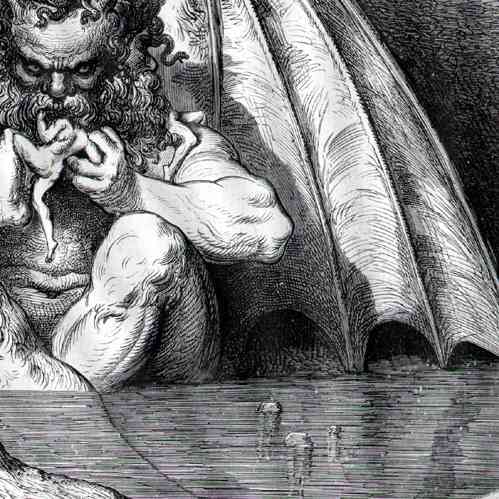
Written 112 years prior, Dante’s epic piece is considered by many to be the quintessential illustration of Hell’s anatomy (as well as Purgatory and Heaven). In the last circle of his intricate geography of it, the character of Satan is portrayed more as an abstract caricature than an actual character.

In Dante’s poem, Satan is a mindless, bestial-like creature locked in an icy lake. He can’t even speak with any of his three mouths, only because he’s too busy dumbly chewing on the three most notorious of traitors. Even then, it’s also implied that he’s too stupid to even speak a word.


Milton’s portrayal of Satan is a complete 180 from this, and I can’t help but wonder how a general public might have reacted to being ‘tricked’ into having, quite literally, sympathy for the devil himself. Up until then, they had been given these similar ‘embodiment of all evil’ sorts of interpretations, especially from Dante’s work so many years prior. 

Sunday, October 27, 2013

Faustus' Last Monologue

Well, we all knew how this play would end, didn't we? It's no surprise to anyone that Faustus would be getting his one-way ticket into Hell in due time. What we might have not predicted was the way that he handled his imminent damnation. Throughout the entire play we're shown this character who, despite his astounding naivety, is fairly level-headed, at least at first.

As the play progresses, so does Faustus' own personality deteriorate. His pranks are petty, if slightly harmless, but it isn't long before they descend into being downright cruel. Yet despite Faustus' cruelty in his mischief, he still manages to retain that same child-like haughtiness and, in a very light sense of the word, innocence.

This all seems to crumble apart come the last hour of his life on line 140 in Act V scene 2. Upon completely isolating himself from everyone around him, Faustus starts to do the one thing that so many of the characters had begged him to do before, pray for salvation. Up until this very point he has done nothing but shield his true self behind a facade of either curious indifference or boredom.

I don't know about you guys, but this was probably the first time that I've felt legitimately bad for Faustus. I've been sympathetic of his loneliness, sure, but reading his final cry for help being directed towards Mephistophilis of all people, one of the ones dragging him into Hell, really sucker punched me in the gut, and it made me really dearly Faustus cared for him, just in his own selfish way.

Anyone else feel differently about Faustus after this?

Friday, October 11, 2013

You know, Utopia doesn't seem so bad in hindsight...

That the word 'utopia' can literally mean 'no place' says a lot about the fact that, as a species, nothing ever particularly seems to satisfy us. This has been portrayed in multiple ways across multiple medias. Even if the world itself is perfect, there's always that one teensy little imperfection that really makes the deal a lot harder to sell to us. And if it isn't small, then it's either a big problem, or the fact that an entire group of people is so discriminated against that they couldn't possibly see the world in the same fashion, thus no longer making it a utopia.


One of the most striking examples of a faux Utopia (although really, aren't they all fake?) is the psychedelic 80's badfest of Logan's Run, where all but a small portion of Earth has been completely wiped out of humans, save for one sole civilization that's dedicated to nothing but for the pursuit of happiness and 'earthly pleasures'. Sounds great, right? Just as good as More's Utopia!

There's a slight problem. In the utopia of Logan's Run, every citizen must die as soon as they turn 30.

More's Utopia is a lot less transparent than that, and that's what makes it stand out above literally every other pop cultural 'utopia' rendition that we've seen in the last 50 years. With movies and books like "The Hunger Games" and a couple of notable Star Trek episodes it's different, because can plainly see just what exactly is 'wrong' with whatever is going on the the world.

With More's Utopia, I could honestly think of a handful of people that I know who would be perfectly happy to move there (provided certain elements are updated to fit a more 'modern' era. At least there's that.

Tuesday, October 8, 2013

Utopia - Would You Live There?

After reading Book II of Utopia, I have to say that I feel extremely conflicted about the lifestyle of the Utopians. A lot of the society in which these people live in seems both good and bad, at least 'bad' by our standards today.

On the negative end of the stick, the concept of 'freedom' in Utopia seems skewed. Every citizen is supposed to toil in farm work at some point in their lives no matter what. No citizen can go outside their city borders without permission (and if they do leave without permission, then they're given severe punishment). Every citizen must abide by the same schedule day after day. Pre-marital intercourse is met with a banning of ever getting married. On top of all of that, there is literally no privacy at all.

However, there is a major positive to their society, one that we could benefit from even today. The entire livelihood of the Utopians centers around mutual nourishment. Everyone gives and everyone takes from each other in a constant back and forth. Food in surplus is given to towns in shortage, for example. Since there is no sense of 'ownership' in Utopia, everyone 'owns' everything and is given what they need to survive, and they in turn give back just as much.

I suppose that this is the one huge thing about Utopia that makes it such a paradise to us, the concept that man can survive off of his fellow man. It's an interesting philosophy, and it's what really makes Utopia what it is as an example of mutual benefit at the cost of not being able to claim ownership over anything material.

But is that kind of thing really worth it compared to how almost everything else seems restricted? I haven't even touched their use of slavery either.


How did you guys feel about the Utopian lifestyle? Honestly, I was just more and more unsettled the more that I read Book II. There are just so many little things that really makes the idea of it uncomfortable for me.

Sunday, October 6, 2013

Dense but Foreboding

Utopia was a tough read in just how utterly dense that it was. With all of the footnotes splattering the bottoms of every page, I felt like I was reading a huge elaborate inside joke that would take a long, long while for me to totally understand.

But once I started to get into it, I saw that it really is easy to see just how much Utopia can apply to even our modern world today, especially when it comes to Raphael's teachings on punishment and government. Maybe that says something about our general ineptitude as a species to keep the masses in line, or maybe it just says how impossible that such a task really is in reality and execution.

That's why I'm immensely curious about what this 'Utopia' island is actually like that Raphael can't stop saying enough nice things about. Is it really as much of a paradise as he claims it to be? Or is there some kind of dark and cruel underlying factor that'll make the island altogether undesirable to any approaching outsider?

I'm being cynical again when it comes to these kinds of stories and books, but I'll just say that a far-fetched land like Utopia has to have a dark undertone to it, or at least that very one 'thing' that'll make the narrator (More himself) turn his head and question the island's validity.

Thursday, September 26, 2013

The Wife of Bath in Today's Media

In ye olden middle English times, of course it would make sense for the Wife of Bath to manipulate her husbands with sex and a quick-silver tongue. As a woman of that time frame, those are the only tools at her disposal, and she makes use of them very, very well. It's almost terrifying to imagine what she might have been capable of our modern times.

It's here that I bring up a point that was made in class (by Jordan, if I remember correctly). The point was that, while the wife's method of getting what she wanted seems perfectly acceptable considering her limited resources, in today's society she'd simply be regarded as someone much less credible. Women these days have so many opportunities to draw upon, almost as much as men, so they have no reason to devolve into petty promiscuous activities in order to get what they want.

But isn't this kind of behavior something that we see in female characters a lot these days?

(taken from www.telegraph.co.uk)

The most obvious example that I can think of is Irene Adler from the BBC adaptation of Sherlock Holmes, and it just so happens that she shares a number of traits with the wife. She manipulates men with her body, to the point of even working as an S&M escort. She baffles Sherlock with seduction and blatantly uses both him and others in order to get what she needs. She has access to an innumerable amount of classified government secrets and possesses amazing intelligent as well.

Despite using many of the same tactics and holding a similar mindset to the wife (you know, excluding the whole line of husbands and acceptance of physical abuse thing), Irene is often regarded as an atypical strong female character, and certainly not a whore. 

It makes me wonder: if you were to take away the cultural acceptance of domestic abuse, would the wife's character be as positively regarded as a 'well-developed character' by our media standards set today? 


Tuesday, September 17, 2013

No One Crusades like the Knight

Though I have not yet read up more on him, I feel the need to make a few comments regarding the 'Knight' of "The Canterbury Tales". Someone in class (I forgot who. Sorry!) mentioned the possibility of the speaker's comments on the Knight being skewed or biased. Considering that this text is being done through, in effect, two narrators, I think the possibility of the Knight being not as 'parfit' as we might think is a perfectly reasonable prediction.

Just who is the Knight? Well, from the passage that we were given in class (lines 43 to about 79), he's every definition of a perfect gentleman. He's been in multiple crusades (we'll ignore how physically impossible that is), been to dozens of places across the world, loves chivalry, and has a good reputation on his shoulders for being the best Knight who ever was.

Before anyone cries 'Mary Sue!', allow me to make note of another well-known character who shares a few similarities with the Knight.

(Taken from entertainmentexcess.com)

Most of us remember Gaston from Disney's Beauty and the Beast, right? He's the town hero! Always swooping in and herding around the simple-minded townsfolk, as well as having a number of copy-pasted ladies fawning over him where ever he goes. He's strong, completely illiterate (as shown), has a reputation for being 'the best', probably has traveled about and even has his own mead hall! By all appearances, he's a perfect man of his society, just like the Knight.

Of course, we all know that isn't 'really' the case. Underneath his super-perfect exterior, Gaston is a misguided (albeit sexist and spoiled) guy who has so much pride that even Beowulf would blush. He's a parody of the archetypal 'Hero' completely lampooned throughout the film.

It's characters like Gaston that make me suspicious of characters like the Knight, this seemingly perfect individual whose just going out on his religious pilgrimage. As we keep reading on about him, I know that I'll be watching for any possible 'tics' in his personality, those little hints that might let on that he's not as noble as we might assume. Maybe he's a total jerk himself (despite the speaker mentioning his lack of 'vileinye' (70)), or maybe just misguided and simple-minded. Maybe I'm just being cynical.