Thursday, September 19, 2013

Monsters and Beowulf

I’m very intrigued by the definition of a monster. The Oxford Dictionary describes a monster as:

Something extraordinary or unnatural; a malformed animal or plant; a fetus, neonate, or individual with a gross congenital malformation, usually of a degree incompatible with life; a person of repulsively unnatural character, or exhibiting such extreme cruelty or wickedness as to appear inhuman; a monstrous example of evil, a vice, etc.; an ugly or deformed person, animal, or thing.

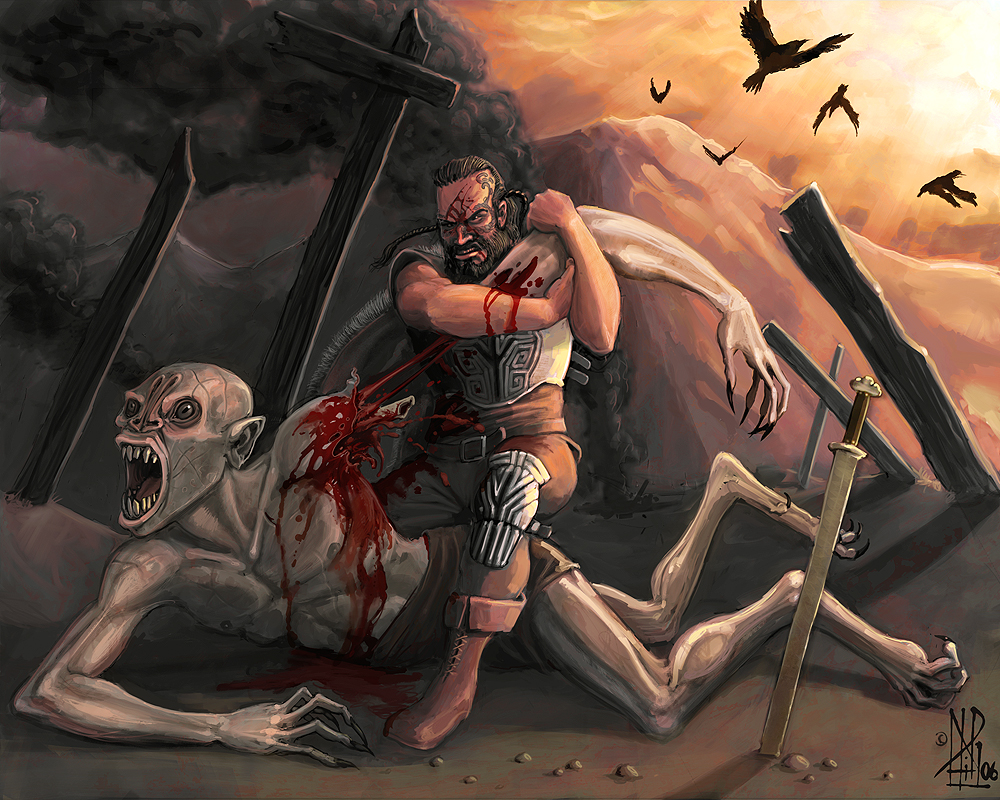
In the epic poem Beowulf, Grendel easily fits this definition. Grendel is described as “a powerful demon” (86), “a fiend out of hell” (100), and “[dwells] in misery among the banished monsters, Cain’s Clan, whom the Creator had outlawed and condemned as outcasts” (106-107).  


Every description in Beowulf seems to focus on Grendel’s character, not his appearance. There is no description of what he looks like, only how he acts. He acts a fiend, he is God-cursed, and he is a miserable wretch. Not once does it say if he is covered in hair, lumpy or bumpy, or a creepy creature. He is a monster to these people because of his inhuman actions. Because he dwells in the bogs and murders and eats people he is a monster; which fits the Oxford definition “exhibiting extreme cruelty or wickedness.”

He may not have money, but he's got the goods.

My favorite character we discussed in class yesterday was the "povre PERSOUN" (478). Although the man is described as being poor, I think he lives a very rich life.

I personally believe that some things are more important than money, and the man depicted in lines 477-528 possess several qualities that outweigh his lack of funds. Chaucer describes him as a "lerned man, a clerk" (480). He's a smart man, which implies that he knows how to live a comfortable life even though he does not have a lot of money. He is able to live in a way that coincides with his income.

Not only does he live a comfortable life, he lives a life he loves. He does not let his financial standing determine his outlook on the world. Chaucer writes, "Wyd was his parisshe, and houses fer asonder/But he ne lafte nat, for reyn ne thonder/in siknes nor in meschief, to vyste" (491-493). It did not matter if the weather was unbearable or if he was sick, he still went to visit everyone in his parish. This man believes that it is a shame to have a corrupt or lazy "shepard" and people who are inherently good. If a priest does not do his job correctly, it does not matter how the people in the parish behave. It is the job of the priest to be a good "leader" and make sure the people of his parish are happy and healthy and not in need of anything. The priest Chaucer writes about is the epitome of this.

It is easy for the reader to accept this as a fact because Chaucer goes on to write, "A bettre preest I trowe that nowher noon is" (524). The priest described in these lines is the best priest known to the narrator. He is what other priests should aspire to be like.

Persoun Beowulf


      This may seem like an unlikely juxtoposition and many will likely disagree, but I couldn't help but notice some similarities between the character of Beowulf and that of the Persoun in The Canterbury Tales. The Persoun, or parson, is clearly presented as a role model for his parishioners, or his “people” if you will. In the text, we see he is the epitome of one who practices what he preaches. He expects his “flock” to follow his lead, never asking them to act or live in a manner that he won't also. His moral code and spiritual expectations are reasonable and doable – how do we know? because he is a living example that they are. Figuratively speaking, he refuses to lead his flock into uncharted territory that he himself has not already trod. As Chaucer points out, rather than taking the easy road, like many of the more seasoned country parsons, he stays to tend to those in his parish. Unlike some of the other characters in this text, the parson clearly takes his role seriously and Chaucer makes it clear that he is not the type of clergy to slack off on his duties or take advantage of divergent opportunities like some other corrupt members of the Church. He is a leader. And what leader would expect his followers to adhere to a different set of rules or expectations than he himself does.


     This is where my argument for Beowulf and his comparable traits comes in. I know a few classes back, several of us debated what defines the duties and responsibilities of a king – a leader. There were many who felt that Beowulf had not acted within his role, rather he pridefully took it upon himself to fight the dragon when in reality he should have commissioned a warrior to take care of this “dirty work.” I want to argue that, like the parson in The Canterbury Tales, Beowulf was just being a good role model, which I feel is key to being a good leader. Instead of taking the easy way, remaining in safety and sending someone in his stead, Beowulf ventured first where many had not trod. Like the parson, he did his job and he did not enlist another to do what he did not want to do. As a king, Beowulf did not expect his people to go where he did not; he did not just send his minions off to take care of things he was responsible for (eg: the safety of his people). He put the safety of his people first (not his own) and sacrificed his own wants for the good of the people in his kingdom. He walked the walk. He demonstrated what it means to be a good leader: a front-runner one that puts those he is meant to care for over himself, which is exactly the type of leadership qualities the parson exemplifies too.

Original Thoughts of England

Thinking back to the influence map assignment, I realize that most of my ideas of England have been formed by romantic or imaginative stories. I included images in my map of Peter Pan flying across London and Alice (from Alice in Wonderland) in a field before chasing the white rabbit because for me, these images gave me my very first impressions of England. I also included pictures of Shakespeare and Jane Austen, which represents romantic ideas through stories of love and tragedy, which are still well known in today’s time, like Romeo and Juliet and Pride and Prejudice. These images are used to show that I tend to view England as a beautiful magical place, which still impacts the way I think of it now.


The other theme that I included in my map had to do with Monarchy and the historical ideas associated with the system, like Robin Hood and Henry VIII. The events that influenced the lives of these people, whether true or not, give a foundation or belief to their legends and history, and explains the fascination that people have with royalty. Even today, there is curiosity and excitement that focus on The Royal Wedding and The Royal Baby (the new prince), since they live lives that many of us will not experience, and as a result, we find them even more interesting.
I wanted to start blogging about my influence map first because we have started reading The Canterbury Tales, and I have realized that I never considered the middle or lower class positions when thinking about England. Logically, I know that there were societal stations, but never gave them much though until reading about the Knight, The Monk, The Parson, and The Miller. I’ve realized that I have had a sheltered view of what England is, but these stories are entertaining because of how they relate to the “common man”.

Wednesday, September 18, 2013

Monk: What's his deal?

So in class recently we went over Chaucer's description of the monk on lines 165-207, and a lot of what we talked about was very interesting.

We basically went over in class how this particular monk was described by Chaucer as being this fat, loud-mouth, well-dressed, rich prick who lives like a lord and owns a lot of horses that he dresses up with bells and whistles and what-not as he parades around town.

What was confusing to me is how this guy could even be considered a monk if he isn't living like one.

It says on lines 184-192 that instead of living his life as "Austin bit," (Augustine bids) he chooses to hunt and live his life based on pleasure instead, eating swans and such. To me, according to the image in my head of a monk (and probably everyone else's in class), this guy just doesn't fit the description. To me, a monk is supposed to live a humble life in a monastery somewhere, praying and fasting all day or something.

It makes me wonder what Chaucer was trying to do in describing the monk this way. Was he trying to satirize the corruption of the church at the time? Or was he simply making this character out to be more complicated, a monk who refuses to live the life that has been set before him by the rigid guidelines of religion? Maybe a little of both?

Use of contrasting characters

First of all I am extremely grumpy because I just typed out a long post thinking I was signed in, just to find out I wasn't. Always awesome! So, I lost everything I had said and do not plan on re stating all of it.

So, I wanted to talk about how in class today we discussed that Chaucer uses his characters to discuss what role a person is supposed to play in society and what role they actually play. I think he uses the knight and the squire to show both ends if this ad well as the parson and the monk, respectively.

The knight is an example, wether you like him or not, of what a knight should be. He is worthy in a positive connotation of the word, noble, and good at what he is supposed to do. Where as the squire is described as a pretty boy, mostly there for show and seems to be about himself and cocky even though he is inexperienced.

The monk clearly corresponds to the squire in this manner, because he is the epitome of what a monk should not be. His vow of poverty is obviously not taken to heart as seen by his extravagant attire and jewelry and his lack of desire to study or work. His counterpart, the parson, is an example of everything a religious follower and leader should be. He puts his people first and shows his commitment in addition to literally practicing what he preaches.

Additionally, I think the maunciple shows this sort of expectation and execution differentiation without even needing a counter character to support him. He brings up the idea of wit vs wisdom, and shows that even though society expects him to be knowledgable and learned, he does his job better by getting by on his wit. This contrast of expectation vs reality and the success the maunciple seems to have by living on the opposite side of expectations makes me wonder where Chaucer is going with the other characters. Does he have some sort of awesome useful purpose for the monk and squire to prove the reader's initial judgements wrong? I think it will be interesting to find out.

Tuesday, September 17, 2013

Ok, so am I the Only One Who Thinks the Knight is a Genuinely Good Guy?

Alright, so in lieu of last class's discussion, I thought it would be kinda cool to put in my own thoughts about the Knight, considering I think I'm the only one who accepts him as this really awesome and cool dude without anything to hide.

Ok, so, let me start off by saying reading this thing in Middle English was a first for me, as well as many of you, and that's just fantastic! Was it just me or did anyone else feel like they were in Skyrim or something while they were speaking? It's awesome, right? Also, might I add, there is actually a place in Skyrim called "High Hrothgar". Tell me that's not a blatant shout out to Beowulf right there?!


Back to the matter at hand, let me just say that this is one of the first stories to actually ever be written down in the history of the English language. Personally, I take this as a sign that one shouldn't really be looking too hard to find anything super crazy in there. This is not to say that the Knight probably hasn't ripped the tag of his mattress or something, but I mean, come on....Chaucer had an unusually large amount of character's to work with here. Do you really think he was huddled over his writing desk and twirling his evil mustache saying "Oh and I'll totally write him as this cool dude, but then I'll make it so he killed his granny with a hammer. MWAHAHAHA!"? Probably not. Some of his characters are drunken assholes, like the Miller, some are gold digging whores turned old ladies with money, Wife of Bath, and some are just Mary Sues like the Knight.

But, hey, I haven't read this since high school so the details are kinda fuzzy. For all I know, my beloved Knight could've ripped the tag off his matress AND murdered his granny with a hammer!

All I'm saying is why would Chaucer write "he was worthy this" and "worthy that" and "never has there been a man who was more worthy than this" (I'm paraphrasing, of course) if he was just gonna make him a dick in the end?

I still believe there are some people who seem to good to be true and I will be the first to admit that the Knight seems to be one of those people. And, I mean, he's fictional. He's allowed to be too good.